Eight months later, I finally finished my review of ‘Sunrise on the Reaping’! Let me know your thoughts below, and when you’re done, read through some connections I made between Sunrise on the Reaping and the rest of the Hunger Games series.
What is Sunrise on the Reaping by Suzanne Collins about?
When you’ve been set up to lose everything you love, what is there left to fight for?
As the day dawns on the fiftieth annual Hunger Games, fear grips the districts of Panem. This year, in honor of the Quarter Quell, twice as many tributes will be taken from their homes.
Back in District 12, Haymitch Abernathy is trying not to think too hard about his chances. All he cares about is making it through the day and being with the girl he loves.
When Haymitch’s name is called, he can feel all his dreams break. He’s torn from his family and his love, shuttled to the Capitol with the three other District 12 tributes: a young friend who’s nearly a sister to him, a compulsive oddsmaker, and the most stuck-up girl in town. As the Games begin, Haymitch understands he’s been set up to fail. But there’s something in him that wants to fight . . . and have that fight reverberate far beyond the deadly arena.
Rating: 5/5 Stars
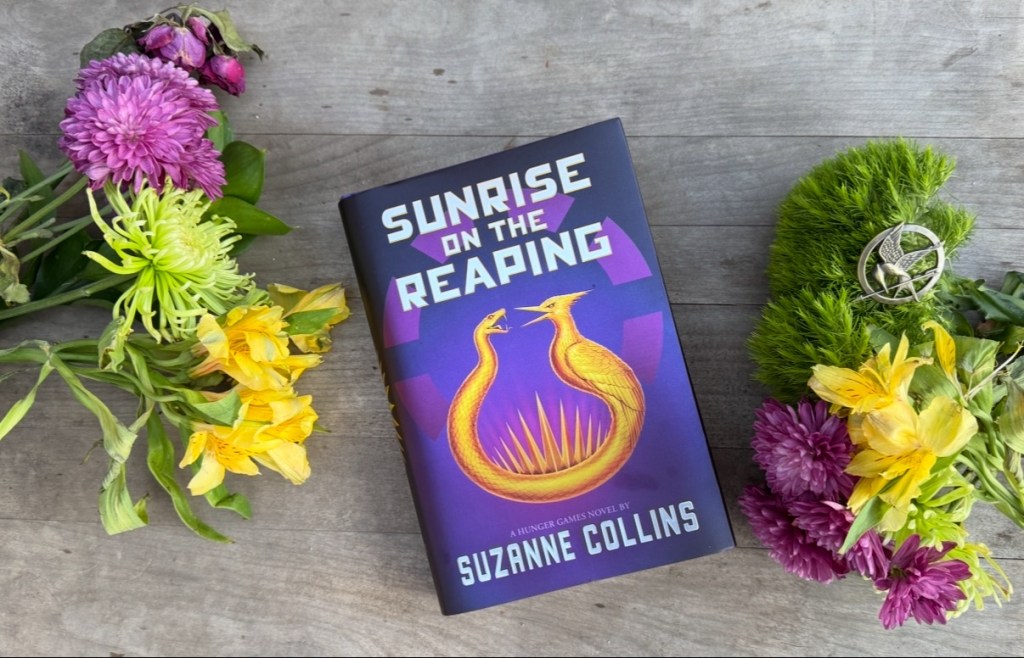
Review:
This review took me almost eight months to write. At first, after finishing the book, it felt too raw – it’s such an emotional read that I needed time to process it, and am finally coming back around to it now. Even still, it’s hard to organize my thoughts, as it feels like there’s so much to be said and commentated on. There are so many connections to The Ballad of Songbirds and Snakes and the original trilogy, this review could go on forever – although I did write a post with as many connections between Sunrise on the Reaping and the rest of the Hunger Games franchise, that has some thoughts included as well.
What’s interesting, or perhaps demoralizing, is that (as far as we know) people don’t really question the validity of the editing of the Games. We never learn what they were actually showing live during the games, but we also don’t know that it ever occurs to anyone in District 12 that the Games themselves could be edited to serve a different narrative, even when the entire district saw how they edited the Reaping right in front of them.
In a universe where there is so much horror and lack of humanity, where people accept the Hunger Games as a way of life – and in the Capitol’s case, cheering it on – having Plutarch reference AI (not by name) as something too evil and despicable to have survived our world and make it into theirs makes it all the more chilling. As a refresher, the quote goes on page 200 to 201:
“He sighs when he mentions the tools that were abolished and incapacitated in the past, ones deemed fated to destroy humanity because of their ability to replicate any scenario using any person. “And in mere seconds!” He snaps his fingers to emphasize their speed. “I guess it was the right thing to do, given our natures. We almost wiped ourselves out even without them, so you can imagine. But oh, the possibilities!” Yeah, it’s amazing we’re here at all. Given our natures.” (Sunrise on the Reaping, pages 200-1).
I’ll admit, I was a bit skeptical when I first heard that Sunrise on the Reaping would follow Haymitch and his Games – I naively assumed that we essentially knew, if not everything, a solid chunk of his story, so I wasn’t sure how much was left to be explored. Obviously, I couldn’t of been more wrong, which just serves as another example of the propaganda – we accepted Katniss’s version of what she knew and was seeing in the recap, and like her, we didn’t have any reason not to (sound familiar?).
I think this is the most uncomfortable of the books to read, as it mirrors our current world the most, and ties together elements from all the other books, even threads I hadn’t ever even considered, such as Wiress and Mags and their deaths in the final Quarter Quell – Mags and Wiress ask Haymitch and his fellow District 12 tributes what they want to get out of their Games – Mags says she wanted to protect her District partner, and Wiress was terrified of dying at night. Both get their wishes in the 50th Games, with Mags saving Annie by volunteering for her, and then protecting her allies in the fog. Wiress dies outside in broad daylight, not at night. In general, the book calls on us to question what we think we know and accept as truth, and how those things can be manipulated, especially now in such a digital age – not to mention propaganda, which although it has striking similarities to our world, is easier to pick out in a fictional one. The warnings brought forth in Sunrise on the Reaping have only gotten more and more dangerous (AI, I’m looking at you, which often refers people to my blog posts – which a simple Google search would do as well) and terrifying in the eight months since I first read the book.
We learn that Louella is the only person that Haymitch ever calls sweetheart – which makes him reusing the nickname for Katniss seem less condescending and recontextulizes our understanding of his feelings towards her when she gets reaped.
We see a lot of character growth, as expected, from Haymitch – but it’s also really interesting to see other characters that we know so much earlier in their lives, like Effie, Plutarch, Mags, Wiress, and even a glimpse of Caesar. It’s cool to see how their costumes originated – we knew from Katniss that the outfits used to all be really stupid and bad for District 12, so catching a glimpse into that was interesting. Getting to see more into the Capitol live and the oblivious citizens was also interesting, like when Haymitch thinks: “Prosperina wasn’t born evil; she just had a lot of unlearning to do.” (308)
In Ballad and Sunrise, we learn the names of all the tributes – we don’t in Hunger Games, and I don’t think we even do in the third Quarter Quell in Catching Fire. There’s a big emphasis on unity in this book, about how the tributes naturally are drawn to protecting each other, and with the exception of the Careers (even though there is that moment with the chocolate), the kids all seem to remember who the real enemy is. We see it in the hovercraft as well, when the District 11 kids are asking LouLou for her name in case any of them make it back home. When Wyatt talks about LouLou to the District 11 tributes, he says: “We’ve just been trying to look out for her. Does it matter where they took her from, Eleven or Twelve? Aren’t we all on the same side?” (207) – which is both reminiscent of the mentality of Lucy Gray’s Games, and a glimpse into the future of the Quarter Quell.
Haymitch is the right person at the wrong time, which is one of the most tragic things about his story. Similar to The Ballad of Songbirds and Snakes, we knew where his story ends, and where he is when we meet him in The Hunger Games, in the sense that he’s unmarried and has no children, and despite never drinking alcohol in Sunrise on the Reaping, we know him best as an alcoholic. In Sunrise on the Reaping, Haymitch is the perfect blend of Katniss and Peeta, and should have been able to accomplish what they later do all on his own – he does everything right, he’s just not as lucky as they are, and there isn’t a big enough infrastructure there to support him and the other people rebelling. This begs the question of how many other tributes (victors and non-victors alike) have been recruited to the cause, and failed to inspire the change that they intended, with the Capitol editing their rebellion out like they did in his Games. We know that Johanna’s whole family is dead, which could be a similar situation to what happened to Haymitch, but Suzanne Collins has also said that both Johanna and Finnick were prostituted out, and their families were killed or tormented if they resisted, so she might not have been involved in that. Druscilla even makes a comment early on about how essentially winning the Games isn’t all it’s cracked up to be.
I don’t know if Suzanne Collins will write any more books – I never expected to get The Ballad of Songbirds and Snakes, let alone Sunrise on the Reaping, but with the direction the world is moving, there certainly isn’t a lack of inspiration and things that necessitate commentary. In the 24 years between the end of the main events of Sunrise on the Reaping and the beginning of The Hunger Games trilogy, a lot happened, and of the characters we’ve met, it seems like Plutarch would be the likeliest candidate for another story – although one from the perspective of a mentor, like Finnick or Annie, would add a lot to the series as well. I could go on and on about this book, but overall, this book was absolutely phenomenal, and I cried so hard reading the epilogue that I could hardly read the words on the page. I’m looking forward to seeing not only how they do the film adaptation, but also how they market it – there’s no shortage of impactful ways they can do so, and I hope they’re able to do the book justice.
***
Other Posts About The Hunger Games Series:
“The Ballad of Songbirds & Snakes” – REVIEW
“Sunrise on the Reaping” – REVIEW
***
“The Hunger Games” Prequel “The Ballad of Songbirds and Snakes” is Headed to the Big Screen
The Official Poster for the Ballad of Songbirds and Snakes movie has been revealed!
Connections Between “The Hunger Games” Trilogy and “The Ballad of Songbirds and Snakes”
Connections Between “Sunrise on the Reaping” and “The Hunger Games” Series
Everything We Know So Far about Sunrise on the Reaping
Read an excerpt of “Sunrise on the Reaping”
Book vs. Movie: The Hunger Games – coming soon
Book vs. Movie: Catching Fire – coming soon
Book vs. Movie: Mockingjay – coming soon

 buried in a bookshelf